E&E Graduate Julia Van Etten, Currently an Assistant Professor in the Department of Biology at the University of Maryland, Studies Rare Paulinella to Investigate the Early Evolution of Photosynthesis


About the Ecology and Evolution Graduate Program
The Ecology and Evolution Graduate Program at Rutgers University aims to foster a diverse environment rich in critical thinking and open communication. We are committed to mentoring the next generation of scientists to solve 21st century problems and be stewards to our planet.
Ecology and Evolution at Rutgers has a long and distinguished history. The E&E graduate program includes approximately 80 faculty and 50 graduate students. The program faculty is comprised of roughly 25 professors who are members the undergraduate Department of Ecology, Evolution, and Natural Resources, the remaining members of the graduate program hail from other departments and campuses. The graduate program is interdisciplinary in nature and offers graduate education and training in microbial, plant, animal, and human ecology under the direction of outstanding faculty located at three campuses (New Brunswick, Newark, and Camden); two marine stations (in Tuckerton and Bivalve); and the Cary Institute for Ecosystem Studies in Millbrook, New York.
Members of the faculty actively pursue research in conservation biology, ecosystem ecology, evolutionary biology, marine biology, microbial ecology, population and community ecology, population genetics, and restoration ecology.
Students may study toward either M.S. or Ph.D. degrees. An M.S. is not required to enter the Ph.D. program. The graduate program falls under the auspices the School of Graduate Studies from which the final degrees are conferred.
The Fall 2026 deadline for application submission to be considered for an internal fellowship is December 1, 2025. Learn more about the application process.
E&E Graduate Program Seminars every Thursday during the fall and spring semesters at 4:00 p.m. This seminar series presents speakers invited from inside and outside Rutgers University to speak on the most current research being conducted in the fields of ecology and evolution. Check out the Program Seminars page for more info.
Graduate student seminars are presented every Friday durng the fall and spring semesters at 4:00pm. These seminars are informal gatherings where graduate students present their current research and other topics of interest to their peers. Information on the 2023-24 seminars can be found on the Student Seminars page.
News
E&E Graduate Julia Van Etten, Currently an Assistant Professor in the Department of Biology at the University of Maryland, Studies Rare Paulinella to Investigate the Early Evolution of Photosynthesis

Click the image to read the open source article

Planet Forward Correspondent Shaniya Utamidata

Shown in the image are examples of existing point-of-care tools used for human health diagnostics that can be adapted for monitoring the health of wild corals. Thermal stress (thermometer), reproduction (eggs), and disease (virus) are among the most anticipated targets for field-enabled diagnostic tools.

Erin McHale, Ph.D. candidate in the Brooke Maslo lab, studies bats. Her research is featured in a story on News12 TV.
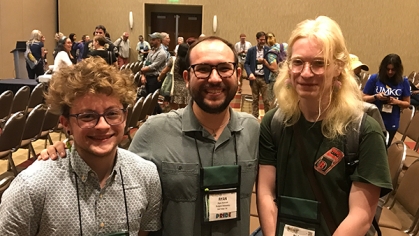
Three SEBS-RU students mentored by Lena Struwe received national awards at the international Botany 2023 conference.